Forget the Cricket Pitch: These 5 Indian Teens Just Conquered the World of Physics
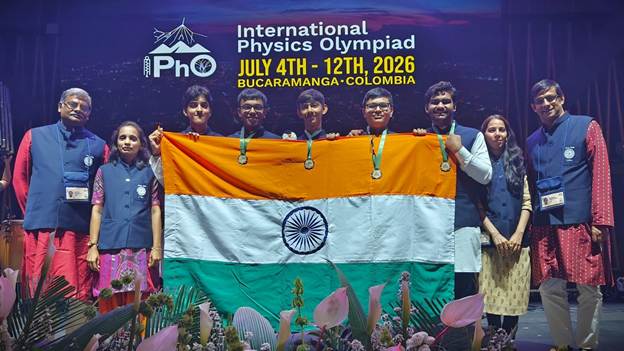
India pulled off a flawless clean sweep at the 56th International Physics Olympiad 2026 in Colombia — all five students won gold, placing India joint World No. 1. Meet the young geniuses behind one of the decade's biggest academic victories.
Forget the Cricket Pitch: These 5 Indian Teens Just Conquered the World of Physics
We can all instantly name India's top batsmen or Olympic track stars. But what about the young minds placing India at the absolute peak of global scientific excellence?
Quietly and decisively, a team of five extraordinary Indian teenagers has just made history on the global stage. At the 56th International Physics Olympiad (IPhO) 2026 held in Bucaramanga, Colombia, the Indian contingent pulled off a flawless clean sweep — every single member won a Gold Medal, sky-rocketing India to the joint World No. 1 spot alongside global science powerhouses like China, Russia, and South Korea.
Here is everything you need to know about the young geniuses who just gave the country one of its biggest academic victories of the decade.
Meet India's Golden Physicists
Out of thousands of students who entered the grueling multi-stage national selection process, only five were chosen by the Homi Bhabha Centre for Science Education (HBCSE) to represent India. They didn't just compete; they dominated.
- Kanishk Jain (Pune, Maharashtra)
- Riddhesh Anant Bendale (Indore, Madhya Pradesh)
- Rishit Garg (Dwarka, New Delhi)
- Shresth Suraiya (Mumbai, Maharashtra)
- Svarit Joshi (Ahmedabad, Gujarat)
Why the Physics Olympiad is a Different Beast
For anyone familiar with standard Indian competitive exams like the JEE, the International Physics Olympiad is an entirely different league. Olympiads don't reward speed, memorization, or shortcuts. Instead, students are subjected to:
- A 5-Hour Theoretical Examination: Testing deep, foundational logic and highly complex conceptual physics.
- A 5-Hour Experimental Laboratory Test: This year, challenging students to tackle complex thermodynamic processes in fluids and heat transfer.
As educators and experts point out, you cannot simply "coach" your way through the IPhO. You either deeply understand the universe's core principles, or you sit in front of a blank paper for five hours. The near-perfect scores achieved by the Indian contingent prove that these five students possess original, world-class scientific minds.
The Minds Behind the Medals
While the spotlight belongs to the students, this victory is also a testament to India's robust Olympiad ecosystem. The team was mentored and guided by exceptional minds, including Prof. Anwesh Mazumdar (HBCSE-TIFR) and Dr. Leena Joshi (St. Xavier's College, Mumbai), alongside scientific observers Prof. Ananda Dasgupta (IISER Kolkata) and Ms. Nisha Kelkar (Gogate-Joglekar College).
Supported continuously by the Department of Atomic Energy (DAE) and the Department of Science and Technology (DST), India's track record at the IPhO is formidable. Over 27 appearances, nearly 44% of all Indian participants have won gold medals, and in the last decade, every single Indian student sent to the IPhO has returned with either a gold or silver medal.
The Bigger Picture: Retaining India's Brightest
While we celebrate this monumental win, it brings a critical question to the forefront of the academic community. Historically, around two-thirds of India's Olympiad medalists go on to pursue elite PhDs, but only about one-third ultimately choose to build their research careers back home in India.
As these five young men head off to choose their futures, the challenge for policymakers and tech leaders is clear: how do we build an ecosystem vibrant enough to ensure that the brightest minds of Yuva Shakti see their futures right here?
For now, Kanishk, Riddhesh, Rishit, Shresth, and Svarit have earned the applause of a nation. It's time we start memorizing the names of our scientific heroes with the same passion we reserve for our sports stars.