The Ride-Hailing Industry Is Broken. Here's What Needs to Change.
Ride-hailing is failing drivers, riders, and even the platforms themselves. This deep-dive explores the structural problems, the fixes that haven't worked, and what a truly fair model needs to deliver.
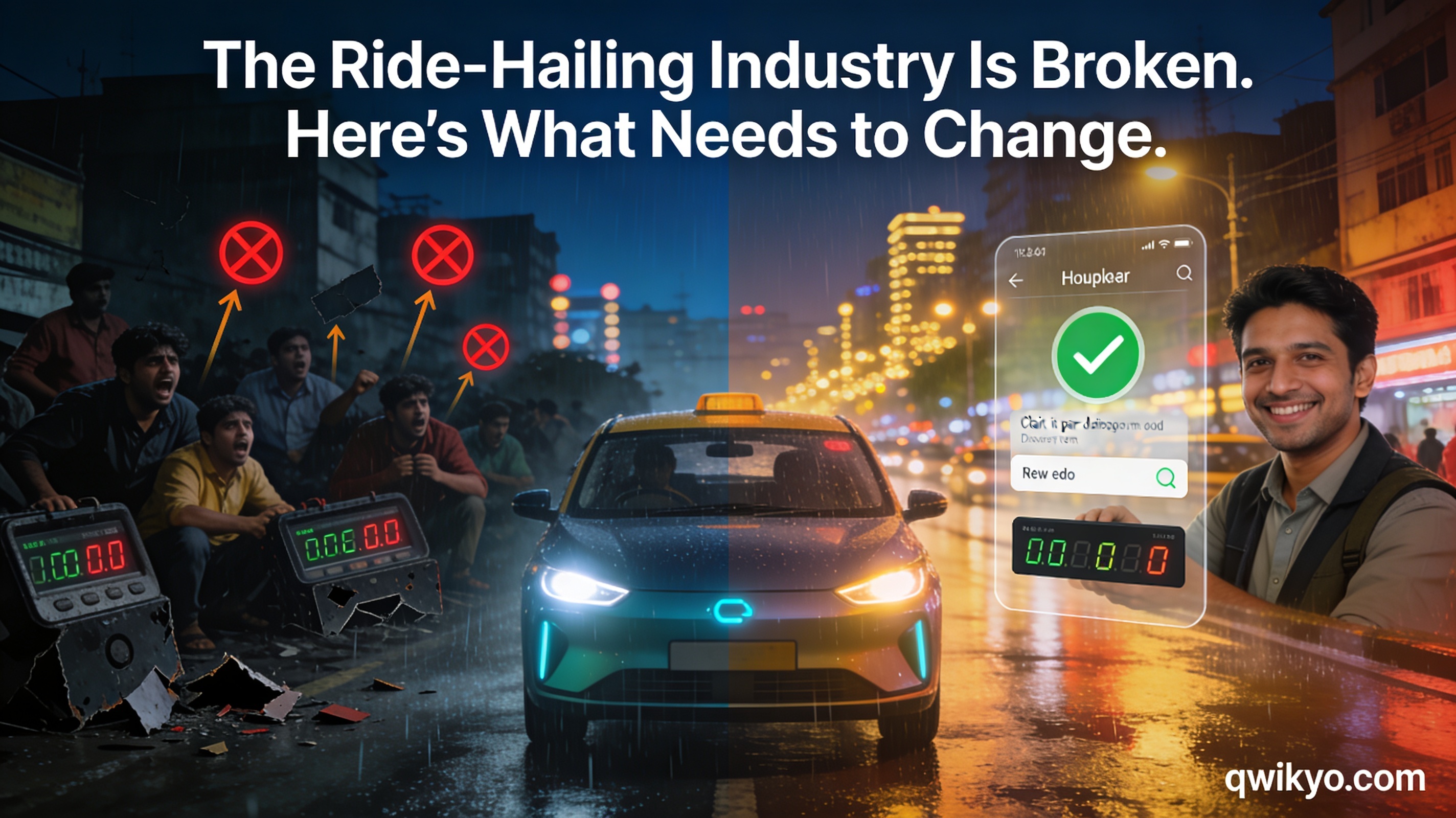
The Ride-Hailing Industry Is Broken. Here's What Needs to Change.
Every day, millions of Indians open a cab-hailing app, book a ride, and wait - only to get a cancellation. They book again. Another cancellation. Meanwhile, the driver who just cancelled is sitting two streets away, waiting for a longer, more profitable trip. Somewhere in between, a platform is collecting its 25% cut and calling it a marketplace.
This is the ride-hailing industry in 2026. And it's broken for everyone.
Drivers Are Losing the Battle
The promise of ride-hailing was simple: drive when you want, earn what you need. For millions of Indian drivers, that promise has worn thin.
Platform commissions of 20-30% eat into every fare. On a Rs150 ride, a driver might take home Rs105 - before fuel, before vehicle maintenance, before the EMI on the car they bought specifically to drive on these platforms. Algorithms set fares that often don't reflect real-world costs. When fares drop too low, drivers reject rides or go offline entirely - not because they're lazy, but because accepting the ride would cost them money.
The result? A workforce that is simultaneously trapped and constantly on the verge of leaving. Driver churn is one of the industry's biggest hidden costs, and nobody talks about it enough.
Riders Are Paying the Price
On the other side of the transaction, riders are dealing with a different kind of frustration.
Surge pricing can double or triple a fare in minutes - during rain, during peak hours, during any event that puts pressure on supply. Cancellations have become so normalised that most riders book two apps simultaneously just to guarantee a ride. Safety concerns, opaque customer service, and zero accountability when things go wrong have eroded the trust that made these platforms successful in the first place.
Riders are not asking for luxury. They are asking for consistency - a fare that makes sense, a driver who shows up, and someone to call when things go wrong. The industry has struggled to deliver even these basics at scale.
The Platforms Are Not as Profitable as They Look
Here's the part that surprises most people: despite charging both drivers and riders, the major ride-hailing platforms have historically struggled to turn a profit. Uber spent over a decade burning cash before achieving consistent profitability. Ola has restructured multiple times. The business of connecting drivers and riders turns out to be extraordinarily expensive.
Why? Because running a ride-hailing platform at scale requires massive spending on:
- Driver acquisition and retention incentives
- Rider discounts and promotional offers
- Technology infrastructure and app development
- Customer support teams handling millions of disputes
- Marketing spend to maintain brand visibility
- Regulatory compliance across dozens of cities and states
Every rupee spent on these overheads has to be recovered somewhere - and it gets recovered through commissions, surge pricing, and fees. The cost structure of the current model makes fairness almost structurally impossible.
What the Industry Has Tried - And Why It Isn't Enough
The industry hasn't been sitting still. Several models have emerged that attempt to fix parts of the problem:
- Zero commission models like Ola's recent India-wide rollout still require revenue from somewhere - usually driver subscription fees or data monetisation. Drivers pay less per ride but still pay.
- Cooperative platforms like Namma Yatri and Bharat Taxi give drivers ownership stakes and remove the commission entirely. These are powerful ideas, but scaling a cooperative across hundreds of cities with millions of drivers is an enormous operational challenge.
- Subscription-based models like Rapido's replace per-ride commissions with a flat weekly or monthly fee. Better for high-volume drivers, but it doesn't solve the fundamental acceptance and fare problems.
Each of these models solves one side of the equation. None of them have cracked all three simultaneously: guaranteed ride acceptance, fair fixed fares, and a platform cost structure that doesn't require extraction to survive.
The Real Problem Is Architecture, Not Intent
Most ride-hailing reform conversations focus on revenue sharing - who gets what percentage. But the deeper problem is architectural.
When a platform costs hundreds of millions of dollars to run, someone pays for it. Change the commission structure without changing the cost structure, and you've just shuffled the burden around. The only way to build a model that is genuinely fair to drivers, genuinely affordable for riders, and genuinely sustainable as a business is to bring the cost of running the platform itself down - dramatically.
That means rethinking dispatch systems. Rethinking customer support. Rethinking onboarding, fraud detection, and dispute resolution. Using AI not as a buzzword but as a genuine cost-reduction tool that handles routine operations at a fraction of the human labour cost. Building infrastructure that works elegantly in low-bandwidth, high-volume, price-sensitive markets like India - not infrastructure designed for San Francisco and copy-pasted to Mumbai.
When the cost per ride drops far enough, the math changes entirely. Drivers can keep more. Riders can pay less. The platform can sustain itself without being extractive.
What a Fixed Model Must Deliver
For the next generation of ride-hailing to actually work, it needs to deliver on five non-negotiables:
- Guaranteed acceptance - drivers should always accept an incoming ride because the compensation structure makes every ride worth taking
- Predictable driver earnings - no algorithmic surprises, no fare fluctuations that punish drivers for circumstances outside their control
- Consistent fares for riders - no surge pricing, no hidden fees, no fare that changes between booking and arrival
- Instant confirmation - riders should know within seconds that their ride is confirmed, not spend minutes watching a spinning booking wheel
- Scalable trust - safety features and dispute resolution that work at 10 million daily rides without requiring an army of support agents
These are not radical demands. They are the minimum viable promise that ride-hailing made in 2010 and has never fully delivered.
The Gig Economy's Defining Test
What happens in ride-hailing matters far beyond cabs and autos. The same structural dysfunction - platform takes too much, workers earn too little, users pay too much - exists across every corner of the gig economy. Delivery. Home services. Skilled tasks. Freelance work.
Ride-hailing is the gig economy's most visible and high-volume sector. If a new model can make it work here - fairly, sustainably, and at scale - it becomes the template for how every gig platform should be built.
At Qwikyo, we've built our platform around the belief that gig workers deserve better than extractive middlemen. That technology should reduce friction and cost, not add to it. That fairness and profitability are not opposites - they are, in fact, the only sustainable combination.
The ride-hailing industry is broken. But the solutions are closer than most people realise. The next era won't be defined by which platform spends the most on incentives - it will be defined by which platform has the courage and the architecture to stop needing to.
Qwikyo is India's gig work platform connecting skilled workers and task-seekers across the country. Follow us for more insights on the future of work, gig economy policy, and platform innovation.