The New Economic Patriotism: Why PM Modi Is Asking Indians to Revisit the Covid Playbook
India’s May 2026 'Seven Appeals' are reviving ideas of collective sacrifice, local spending, remote work, and economic discipline. Here’s what it actually means for ordinary Indians.
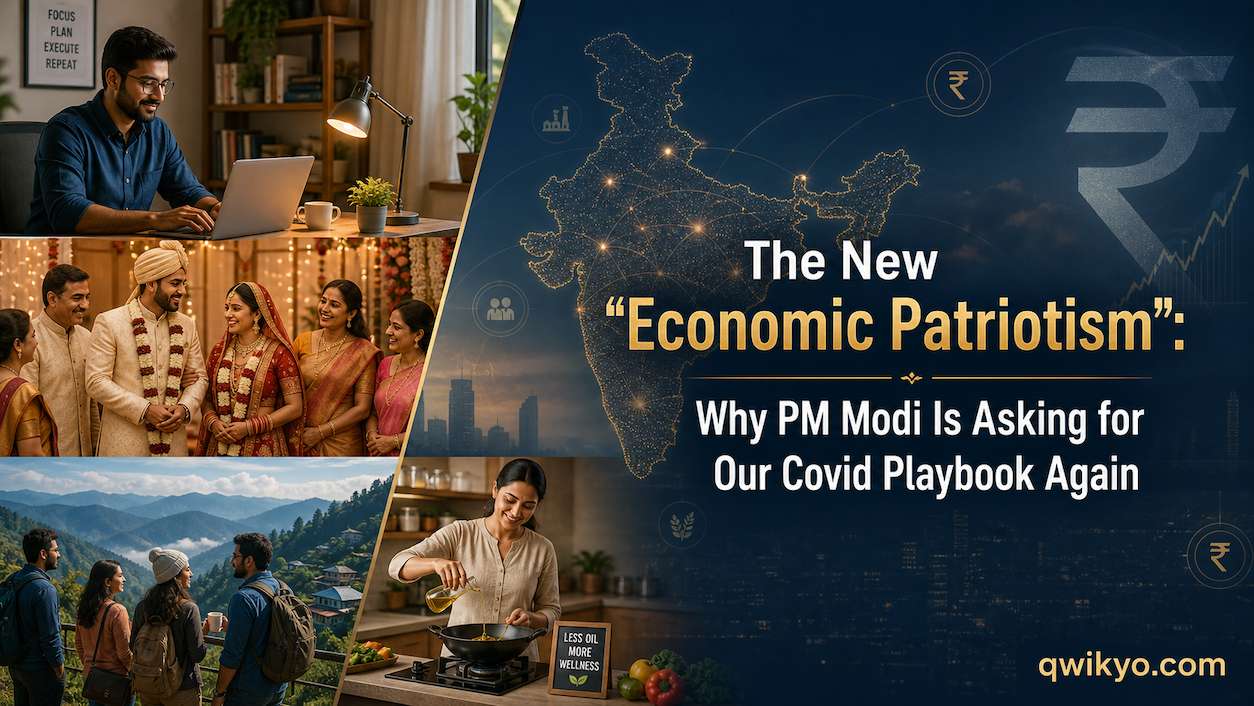
The New “Economic Patriotism”: Why PM Modi Is Asking Indians to Revisit the Covid Playbook
A few days ago, the Prime Minister addressed the nation with a tone that felt strangely familiar.
It wasn’t a victory speech. It wasn’t election rhetoric. It sounded more like a national request for discipline — the kind India last experienced during the pandemic years.
As the West Asia crisis continues to pressure global fuel markets and inflation worries grow louder, the government has rolled out what many are calling the “Seven Appeals” — a set of voluntary behavioral changes aimed at reducing economic strain on the country.
But what makes this moment different is that the government isn’t just depending on policies, subsidies, or central banks.
It’s depending on people.
Not economists.
Not corporations.
Us.
The Return of the Home Office
During Covid, “Work From Home” was survival.
Now, it’s being reframed as something else entirely: economic responsibility.
The logic is straightforward.
Fewer cars on the road means:
- lower fuel consumption,
- reduced import pressure,
- and less strain on India’s foreign exchange reserves.
For millions of Indians, WFH once represented flexibility and freedom. Today, it’s quietly being positioned as a form of national contribution.
And honestly? That shift feels strange.
There’s something surreal about attending Zoom calls in pajamas while simultaneously being told you’re helping stabilize the Rupee.
But in a country that imports a major chunk of its energy needs, even small reductions in daily commuting start adding up at scale.
Putting the “Big Fat Indian Wedding” on a Diet
This might be the most emotionally difficult appeal of all.
The suggestion to avoid extravagant overseas weddings and postpone non-essential gold purchases touches something deeply cultural.
Because in India, gold isn’t just fashion.
It’s:
- family security,
- generational wealth,
- social identity,
- and emotional comfort.
For decades, buying gold has symbolized stability in uncertain times.
But from an economic perspective, gold imports create massive outflows of foreign currency. And when global conditions become unstable, those outflows matter more than ever.
That’s why the message feels less like a financial instruction and more like a cultural sacrifice:
celebrate locally, spend carefully, and keep capital inside the country.
For many middle-class families already balancing inflation, EMIs, school fees, and rising travel costs, this isn’t a small adjustment.
It’s personal.
Travel Local, Think National
The government’s appeal to prioritize domestic tourism over international vacations has also sparked conversation online.
Swap Europe for Himachal.
Choose Kerala over Thailand.
Explore Northeast India before booking Switzerland.
At first glance, it sounds patriotic.
But economically, the idea is about something much simpler:
keeping Indian money circulating within India.
Every foreign vacation increases outward currency flow. Every domestic trip supports:
- local hotels,
- transport workers,
- restaurants,
- guides,
- artisans,
- and small tourism businesses.
And after years of uneven recovery across sectors, many local economies genuinely need that support.
Ironically, this could become an unexpected win for Indian tourism itself.
A lot of people spent years dreaming about international travel while barely exploring their own country.
Maybe this moment changes that.
Even the Indian Kitchen Is Part of the Strategy
One of the lesser-discussed appeals focused on reducing edible oil consumption and encouraging more natural farming practices.
Again, the reasoning comes back to imports.
India depends heavily on imported cooking oils, making everyday household consumption vulnerable to global supply disruptions and price spikes.
Which means something as ordinary as:
- how much oil we use,
- what we cook,
- and where ingredients come from,
suddenly becomes connected to national economic resilience.
That’s the strange reality of interconnected economies:
global crises eventually land on the kitchen table.
So… Does Any of This Actually Work?
Critics argue that lifestyle adjustments cannot solve structural economic problems.
And they’re right — at least partially.
No amount of skipped vacations or postponed jewelry purchases can single-handedly fix global oil shocks or geopolitical instability.
But India’s size changes the equation.
When 1.4 billion people make even modest behavioral shifts:
- fuel demand changes,
- import pressure eases,
- local spending increases,
- and national consumption patterns begin moving together.
The pandemic already proved something important:
micro-actions scale faster in India than almost anywhere else in the world.
Mask adoption. Digital payments. Remote work. Online commerce.
Once collective momentum starts, behavior changes rapidly.
And maybe that’s the real idea behind these appeals.
Not austerity.
Not fear.
But coordination.
A Different Kind of Patriotism
There’s an older word quietly returning to public conversation lately:
Swadeshi.
Not in the dramatic, slogan-heavy way people often imagine — but in subtle daily choices.
Work remotely when possible.
Travel domestically.
Buy thoughtfully.
Consume less wastefully.
Support local businesses.
None of these actions feel revolutionary on their own.
But together, they create a version of economic patriotism that looks less like politics and more like collective restraint.
And in a world becoming increasingly uncertain, maybe that’s exactly what the government is hoping for.
Final Thoughts
The “Seven Appeals” are ultimately asking Indians to think differently about ordinary life.
Your commute.
Your wedding budget.
Your vacation plans.
Your cooking habits.
Things that once felt purely personal are now being framed as part of a broader national economic story.
Whether people fully embrace these changes remains to be seen.
But one thing is clear:
India is once again being asked to fight a national challenge not just through policy — but through behavior.
And if the Covid years taught us anything, it’s that collective discipline in India can become a powerful force very quickly.
What do you think?
Would you postpone a gold purchase, reduce fuel consumption, or switch back to remote work if it genuinely helped the economy?
The conversation around economic patriotism is only getting started.